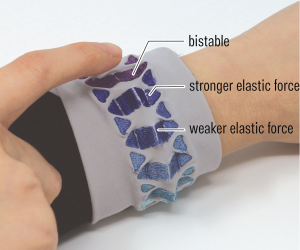
Embrogami: Shape-Changing Textiles with Machine Embroidery Abstract Machine embroidery is a versatile technique for creating custom and entirely fabric-based patterns on thin and conformable textile surfaces. However, existing machine-embroidered surfaces remain static, limiting the interactions they can support. We introduce Embrogami, an approach for fabricating textile structures with versatile shape-changing behaviors. Inspired by origami, we leverage machine embroidery to form finger-tip-scale mountain-and-valley structures on […]
Posted: 27/08/2024
Under:
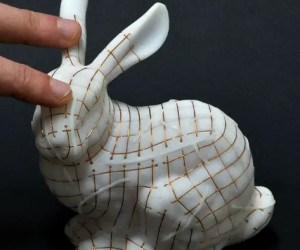
Capacitive Touch Sensing on General 3D Surfaces Abstract Mutual-capacitive sensing is the most common technology for detecting multi-touch, especially on flat and simple curvature surfaces. Its extension to a more complex shape is still challenging, as a uniform distribution of sensing electrodes is required for consistent touch sensitivity across the surface. To overcome this problem, we propose a method to adapt the sensor layout […]
Posted: 22/07/2024
Under:
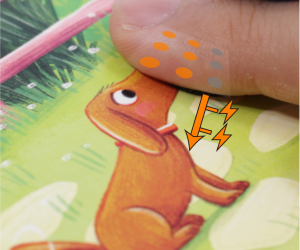
Shaping Compliance Inducing Haptic Illusion of Compliance in Different Shapes with Electrotactile Grains Abstract Compliance, the degree of displacement under applied force, is pivotal in determining the material perception when touching an object. Vibrotactile actuators can be used for creating grain-based virtual compliance, but they have poor spatial resolution and a limiting rigid form factor. We propose a novel electrotactile compliance illusion that renders grains […]
Posted: 16/04/2024
Under:
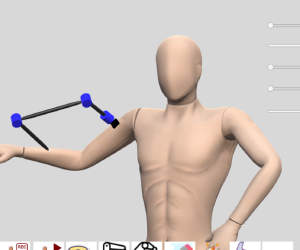
WRLKit: Computational Design of Personalized Wearable Robotic Limbs Abstract Wearable robotic limbs (WRLs) augment human capabilities through robotic structures that attach to the user’s body. While WRLs are intensely researched and various device designs have been presented, it remains difficult for non-roboticists to engage with this exciting field. We aim to empower interaction designers and application domain experts to explore novel designs and applications by […]
Posted: 25/08/2023
Under:
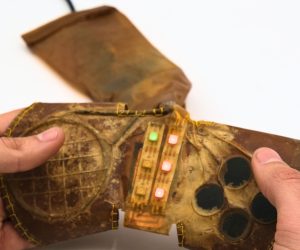
Biohybrid Devices: Prototyping Interactive Devices with Growable Materials Abstract Living bio-materials are increasingly used in HCI for fabricating objects by growing. However, how to integrate electronics to make these objects interactive still needs to be clarified. This paper presents an exploration of the fabrication design space of Biohybrid Interactive Devices, a class of interactive devices fabricated by merging electronic components and living organisms. From the […]
Posted: 25/08/2023
Under:
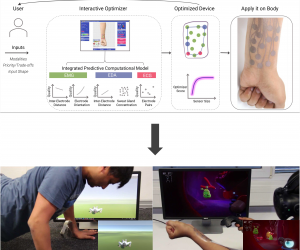
Computational Design and Optimization of Electro-Physiological Sensors Abstract Electro-physiological sensing devices are becoming increasingly common in diverse applications. However, designing such sensors in compact form factors and for high-quality signal acquisition is a challenging task even for experts, is typically done using heuristics, and requires extensive training. Our work proposes a computational approach for designing multi-modal electro-physiological sensors. By employing an optimization-based approach alongside an […]
Posted: 03/11/2021
Under:
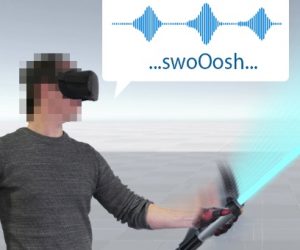
Weirding Haptics In-Situ Prototyping of Vibrotactile Feedback in Virtual Reality through Vocalization Effective haptic feedback in virtual reality (VR) is an essential element for creating convincing immersive experiences. To design such feedback, state-of-the-art VR setups provide APIs for programmatically generating controller vibration patterns. While tools for designing vibrotactile feedback keep evolving, they often require expert knowledge and rarely support direct manipulation methods for mapping feedback […]
Posted: 13/10/2021
Under:
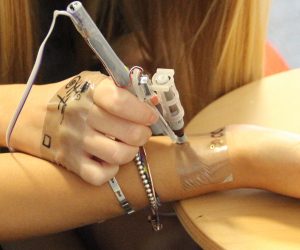
BodyStylus Freehand On-Body Design and Fabrication of Epidermal Interfaces In traditional body-art, designs are adjusted to the body as they are applied, enabling creative improvisation and exploration. Conventional design and fabrication methods of epidermal interfaces, however, separate these steps. With BodyStylus we present the first computer-assisted approach for on-body design and fabrication of epidermal interfaces. Inspired by traditional techniques, we propose a hand-held tool that […]
Posted: 28/01/2021
Under:
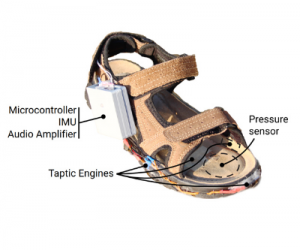
bARefoot Generating Virtual Materials using Motion Coupled Vibration in Shoes Many features of materials can be experienced through tactile cues, even using one’s feet. For example, one can easily distinguish between moss and stone without looking at the ground. However, this type of material experience is largely not supported in AR and VR applications. We present bARefoot, a prototype shoe providing tactile impulses tightly coupled […]
Posted: 02/01/2021
Under:
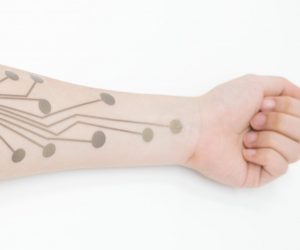
PhysioSkin Rapid Fabrication of Skin-Conformal Physiological Interfaces Advances in rapid prototyping platforms have made physiological sensing accessible to a wide audience. However, off-the-shelf electrodes commonly used for capturing biosignals are typically thick, non-conformal and do not support customization. We present PhysioSkin, a rapid, do-it-yourself prototyping method for fabricating custom multi-modal physiological sensors, using commercial materials and a commodity desktop inkjet printer. It realizes ultrathin skin-conformal […]
Posted: 29/07/2020
Under:


Recent Comments