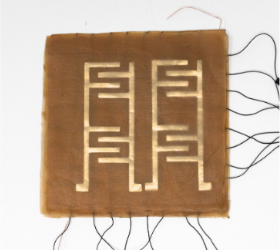
Biomaterials for Prototyping in HCI Abstract While prototyping is a widespread practice among researchers, creating sustainable, functional devices remains challenging due to the limited range of available tools and materials. We present several approaches to sustainable prototyping of functional devices. Our methods range from using bio-based and bio-degradable materials as sustainable alternatives to biologically growing electronic substrates. These methods enable a new class of interactive […]
Posted: 11/08/2025
Under:
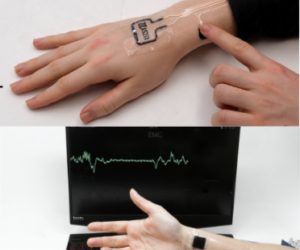
Living Layers: Designing Modular E-Skin with Bacterial Cellulose Abstract Due to its flexibility and sensitivity, E-skin is increasingly used in applications in fields such as Human-Computer Interaction (HCI), biomedical engineering, and robotics. However, current e-skin technologies face challenges related to durability, self-healing, and sustainability. Addressing these issues, sustainable materials offer promising alternatives with unique physical properties. In this context, we explore how the inherent characteristics […]
Posted: 11/08/2025
Under:
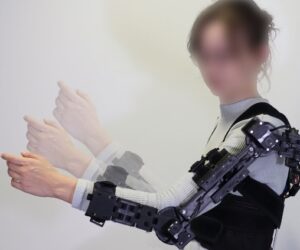
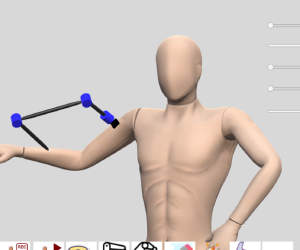
ExoKit: A Toolkit for Rapid Prototyping of Interactions for Arm-based Exoskeletons Exoskeletons open up a unique interaction space that seamlessly integrates users’ body movements with robotic actuation. Despite its potential, human-exoskeleton interaction remains an underexplored area in HCI, largely due to the lack of accessible prototyping tools that enable designers to easily develop exoskeleton designs and customized interactive behaviors. We present ExoKit, a do-it-yourself toolkit […]
Posted: 14/02/2025
Under:
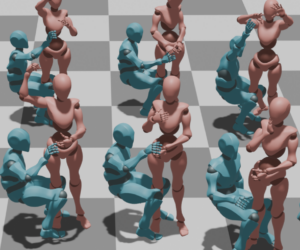
3HANDS Dataset: Learning from Humans for Generating Naturalistic Handovers with Supernumerary Robotic Limbs Abstract Supernumerary robotic limbs are robotic structures integrated closely with the user’s body, which augment human physical capabilities and necessitate seamless, naturalistic human-machine interaction. For effective assistance in physical tasks, enabling SRLs to hand over objects to humans is crucial. Yet, designing heuristic-based policies for robots is time-consuming, difficult to generalize across […]
Posted: 12/02/2025
Under:
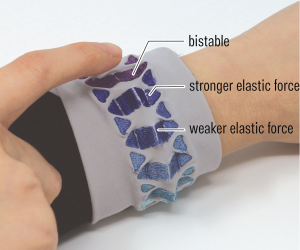
Embrogami: Shape-Changing Textiles with Machine Embroidery Abstract Machine embroidery is a versatile technique for creating custom and entirely fabric-based patterns on thin and conformable textile surfaces. However, existing machine-embroidered surfaces remain static, limiting the interactions they can support. We introduce Embrogami, an approach for fabricating textile structures with versatile shape-changing behaviors. Inspired by origami, we leverage machine embroidery to form finger-tip-scale mountain-and-valley structures on […]
Posted: 27/08/2024
Under:
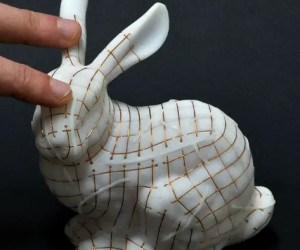
Capacitive Touch Sensing on General 3D Surfaces Abstract Mutual-capacitive sensing is the most common technology for detecting multi-touch, especially on flat and simple curvature surfaces. Its extension to a more complex shape is still challenging, as a uniform distribution of sensing electrodes is required for consistent touch sensitivity across the surface. To overcome this problem, we propose a method to adapt the sensor layout […]
Posted: 22/07/2024
Under:
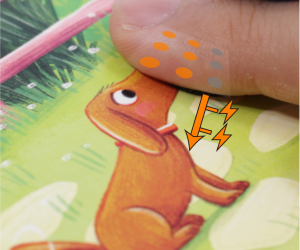
Shaping Compliance Inducing Haptic Illusion of Compliance in Different Shapes with Electrotactile Grains Abstract Compliance, the degree of displacement under applied force, is pivotal in determining the material perception when touching an object. Vibrotactile actuators can be used for creating grain-based virtual compliance, but they have poor spatial resolution and a limiting rigid form factor. We propose a novel electrotactile compliance illusion that renders grains […]
Posted: 16/04/2024
Under:
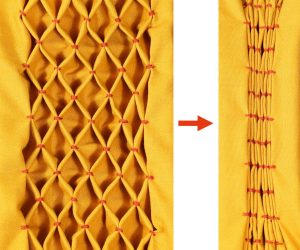
Flextiles Designing Customisable Shape-Change in Textiles with SMA-Actuated Smocking Patterns Abstract Shape Memory Alloys (SMAs) afford the seamless integration of shape-changing behaviour into textiles, enabling designers to augment apparel with dynamic shaping and styling. However, existing works fall short of providing versatile methods adaptable to varying scales, materials, and applications, curtailing designers’ capacity to prototype customised solutions. To address this, we introduce Flextiles, parameterised SMA […]
Posted: 29/02/2024
Under:
WRLKit: Computational Design of Personalized Wearable Robotic Limbs Abstract Wearable robotic limbs (WRLs) augment human capabilities through robotic structures that attach to the user’s body. While WRLs are intensely researched and various device designs have been presented, it remains difficult for non-roboticists to engage with this exciting field. We aim to empower interaction designers and application domain experts to explore novel designs and applications by […]
Posted: 25/08/2023
Under:
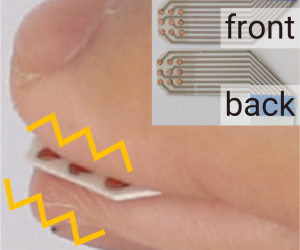
Double-Sided Tactile Interactions for Grasping in Virtual Reality Abstract For grasping, tactile stimuli to multiple fingertips are crucial for realistic shape rendering and precise manipulation. Pinching is particularly important in virtual reality since it is frequently used to grasp virtual objects. However, the interaction space of tactile feedback around pinching is underexplored due to a lack of means to provide co-located but different stimulation to […]
Posted: 25/08/2023
Under:


Recent Comments